

What Is DeFi? Discover the Finance Revolution Without Banks
- Sep 28, 2025
- 9 min read

Borrow money at midnight without asking a bank for permission, sounds wild, right? Thousands already do, using code instead of clerks.
Decentralized finance (DeFi) is a set of open, blockchain apps for saving, borrowing, trading, and earning interest without banks. Smart contracts enforce rules, wallets provide access, and every transaction is transparent.
Fees, speed, and access are shifting fast, and DeFi sits at the center of that change. From stablecoins to on-chain markets, it’s reshaping how money moves across the internet.
What You Will Learn in This Article
What Is DeFi? Think of It as Money Apps Without Banks
Think of DeFi as a set of money apps that run on public blockchains instead of bank servers.
These apps use smart contracts, code that holds funds and follows rules without a clerk in the middle.

From there, anyone with a crypto wallet can connect, see what the contract does, and use it. No appointments. No gatekeepers. This is decentralized finance in plain terms: code, not clerks.
Where DeFi Actually Runs (Ethereum, Solana, and Beyond)
Most activity lives on Ethereum, though you’ll also find busy neighborhoods on Solana and BNB Chain.
The rhythm is simple: a user connects a wallet, the contract checks conditions (collateral, rates, liquidity), and then executes.
Fees are paid to the network, not a bank. Data is public by default, so you can verify what happened, helpful when you’re still learning how these tools handle everyday tasks like saving or swapping.
How DeFi Works Behind the Curtain
Here’s the quick mental model for how DeFi actually operates. Your wallet (MetaMask, Rabby, Trust Wallet) is a keyring, not a bank account. When you hit “swap” or “lend,” your wallet signs a transaction that calls a smart contract’s function.

The contract checks rules, do you have enough balance, is the pool liquid, is your collateral healthy and the network includes that call in a block.
Why Ethereum Still Dominates DeFi and Where Others Fit
Most of this runs on the Ethereum Virtual Machine (EVM), which means code is executed the same way on Ethereum and on many L2s like Arbitrum, Optimism, and Base.
That’s why people say “money legos”: one protocol can route funds through several others in a single flow.
Oracles (Chainlink and others) feed prices; without them, lending markets can’t know when positions should be liquidated. If you want the technical frame, think state machines and shared ledgers: every result is recorded, auditable, and final once confirmed.
Two Safety Habits Every DeFi User Should Know
You give a contract permission to move a token on your behalf; review and revoke old ones now and then.
You pay miners/validators to process your call; use L2s when fees spike. These habits make real-world use feel much smoother.
The Core Building Blocks of DeFi Explained
DeFi has a few pieces you’ll see again and again. Here’s the quick tour, short and sweet.

Smart Contracts: The Code That Replaces Middlemen
These are self-executing agreements. Imagine an escrow that releases funds only when the math says so. Code sets the terms; the blockchain enforces them. If you’re still learning the basics, smart contracts are why strangers can transact safely.
DApps: The Gateways to Using DeFi
The app is just a friendly front door. Underneath, the contract is doing the real work. Wallets such as MetaMask or Trust Wallet sign your actions, and the app passes them to the chain.
Stablecoins: The Everyday Currency of DeFi
Tokens like USDC or DAI aim to hold a steady value so budgeting isn’t a roller coaster. They’re the “cash” leg for lending, trading, and paying fees, key for everyday use.
Liquidity Pools: Fueling DeFi Trading and Lending
Instead of a traditional order book, many DEXs rely on pools filled by users. You deposit two assets, traders swap against the pool, and you earn a slice of the fees. Prices move with supply and demand, which is why “price impact” and “slippage” matter.
Governance Tokens: Why DeFi Users Get a Vote
Holders can propose and vote on changes: fee tweaks, new markets, treasury grants. It’s messy at times, but it gives users a say, shared control is part of the appeal.
Oracles: The Data Feeds That Keep DeFi Honest
Markets need prices. Oracles bring data, like ETH/USD, on-chain. Good oracles reduce weird outcomes; bad ones can cause liquidations no one wanted.
How These Pieces Fit Together in DeFi
Combine these parts and you get a toolkit that explains not only how DeFi functions, but why it feels different: permissionless access, transparent rules, and money that moves as fast as the network.
What Can You Actually Do with DeFi?
Curious what this looks like in practice? Here’s where newcomers often begin once they decide to try it.
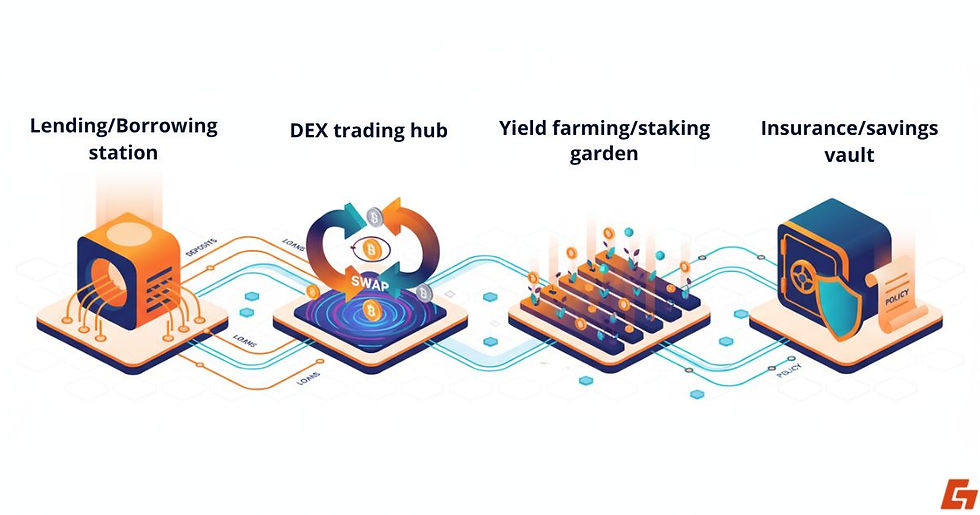
Borrowing and Lending: DeFi’s Digital Credit Markets
Protocols like Aave or Compound let you deposit assets to earn interest or borrow against your collateral. No credit checks, your wallet balance and collateral ratio are what count.
Software enforces limits, sets liquidation thresholds, and keeps markets balanced.
Trading on DEXs: Peer-to-Peer Markets Without Middlemen
Uniswap and SushiSwap allow peer-to-peer swaps with instant settlement. You connect a wallet, choose tokens, review the quote, and confirm. No account forms, no wait times. It’s quick, but watch gas fees and set sensible slippage limits.
Compared with centralized exchanges, custody stays with you until the moment of the swap.
Yield Farming and Staking: Ways to Earn in DeFi
Provide liquidity to a pool and you’ll earn a share of trading fees; some pools also offer token incentives. Staking is different: you lock tokens to help secure a network or support a protocol and receive rewards.
Returns can look tempting, but they fluctuate. Impermanent loss, reward emissions, and token volatility are part of the equation, worth understanding before you chase yields.
Insurance and Savings in DeFi: Protecting Your Assets
Services like Nexus Mutual aim to cover smart-contract failures and other on-chain events. “Savings” products range from conservative vaults that route funds to lending markets to riskier strategies that stack multiple protocols.
Think of it like a menu: simple earn, medium complexity, or spicy experimental, pick carefully and read the docs.
Freedom with Responsibility: Staying Safe in DeFi
All of the above happens through a wallet you control, which is both the freedom and the responsibility.
Approvals grant contracts permission to move tokens; revoking old approvals is a healthy habit. That small routine helps keep your DeFi journey safe while you test the waters.
Why DeFi Appeals: The Key Benefits
No desk clerks, no custody fees, just network costs and protocol fees you can see up front. For newcomers, that transparency is refreshing.

Always Open: 24/7 Access to Money
Markets don’t close. You can repay a loan at 3 a.m., add liquidity on a Sunday, or claim rewards over lunch. That round-the-clock rhythm shows how these tools work in real life.
Open Access: Finance Without Gatekeepers
If you can run a wallet, you can use the protocol. No credit checks, no applications. This permissionless design is a lifeline for users who’ve been underserved.
Transparent by Default: Why Every DeFi Action Is Public
Every transaction is on-chain. You can inspect contracts, audit flows, and track treasury wallets. That built-in audit trail is a big reason people care.
Composability: The “Money Legos” of DeFi
Apps stack. A vault might deposit to a lender that routes through a DEX. That modularity speeds up experimentation and gives users more choices.
The Real Risks and Challenges of DeFi
Bugs and logic errors can drain pools. Audits help but aren’t guarantees. Prefer protocols with time in the market, bug bounties, and transparent teams.

Governance and Economic Risks: When DeFi Gets Shaky
Oracle manipulation, thin liquidity, or rushed governance votes can nuke positions. If a protocol holds admin keys, understand what those keys can change. This is where trust becomes due diligence, not vibes.
Rug Pulls and Clones: Spotting the Red Flags
Flashy yields can mask sloppy code or malicious intent. Check liquidity lockups, token distributions, and whether incentives make sense.
MEV and Slippage: The Hidden Costs of DeFi Trading
Your trade can be sandwiched or suffer worse pricing than quoted. Set slippage limits and use routing tools that try to reduce MEV exposure.
Fees and Friction: Why DeFi Isn’t Always Smooth
High gas on L1 can turn small actions into bad deals. L2s help, but bridging adds its own risk. Newcomers often learn the hard way here, so start small, double-check approvals, and keep notes.
Regulation and Taxes: The Unsettled Side of DeFi
Rules vary by country and change quickly. Track your transactions and speak with a professional where you live.
DeFi offers choice and speed, but only if you respect the risks.
How to Start Using DeFi (Without Losing Your Shirt)
If you’re brand-new and want the practical route, here’s a simple way to try this without risking more than lunch money. You’ll move slowly, double-check everything, and treat each click like it matters, because it does.

First Steps into DeFi: A Beginner’s Path
Step 1: Create a Wallet (Your Digital Key)
MetaMask, Rabby, or Trust Wallet work well. Write the seed phrase on paper (not in your notes app), store two copies in separate places, and add a hardware wallet later if you plan to hold serious value. This is the key in practice: you control access.
Step 2: Add Crypto to Get Started
You’ll need ETH for gas or a stablecoin like USDC to use apps. Buy on a trusted exchange or use a card on-ramp, then withdraw to your wallet. If fees look heavy, consider an L2 like Base, Arbitrum, or Optimism. Bridge only via official links and small test amounts first, most beginners learn fee math here.
Step 3: Connect Safely to a DeFi App
Start with well-known names: Aave (lending), Uniswap (swaps), Yearn (vaults). Open the verified URL, connect your wallet, and read what the transaction is asking permission to do. Approvals let a contract move specific tokens on your behalf; keep limits tight and revoke old ones later.
Step 4: Start Small, Track Everything
Do a $10–$20 test swap or deposit. Note gas used, APRs, and slippage. Use tools like DeBank or Zapper to see positions across chains. A basic spreadsheet helps. It sounds fussy, but this habit makes the mechanics click.
Quick Safety Checklist for Beginners
Bookmark official sites; avoid Google ads and look-alike domains.
Verify contracts on Etherscan; reputable protocols publish addresses.
Set slippage limits; ignore “guaranteed” yields.
Use Revoke.cash monthly to clean up old approvals.
Keep records for taxes, future-you will thank you.
The Future of DeFi: Where It’s Headed Next
Where does this go next? If you’re still wondering how this scales when billions move daily, the answer is: better plumbing, cleaner UX, and more real-world hooks.

Layer 2 Networks: The Next Big Shift in DeFi
Cheaper, faster transactions pull day-to-day activity to L2s. Account abstraction (think: smart wallets that auto-pay fees or batch steps) makes “gas” less scary. That shift alone helps newcomers actually use it.
Cross-Chain DeFi: Seamless Movement Across Networks
Bridges get safer, or are replaced by shared security and messaging. Your assets move where apps are best, not where fees trap you. Under the hood, oracles mature and risk engines consider liquidity across multiple networks, not just one pool.
Real-World Assets in DeFi: Beyond Crypto Hype
Treasuries, invoices, and stablecoins flow through on-chain rails, with institutions touching permissioned versions of the same protocols you use. Settlement stays fast; compliance layers slot in where laws require them.
AI in DeFi: Smarter Risk and Trade Decisions
Smarter models score collateral, predict liquidations, and route trades for less slippage. You won’t need a dashboard forest, just a wallet giving you sane choices and clear warnings.
Governance Evolves: From Token Votes to Real Influence
Token voting gets filters: delegates with reputation, circuit breakers, and time-locked changes. Users still steer, but with seatbelts.
Regulation and DeFi: Friend or Foe?
Rules differ by country, sure, but clearer guidance reduces guesswork for teams and users. The result: more mainstream apps embedding on-chain features behind clean interfaces, swap, save, borrow, without a maze of tabs.
Why This Future Matters for Everyone
If that sounds a bit ambitious, it is. But the arc is visible: simpler wallets, lower fees, safer rails, and money apps that work like the internet, fast, open, and always on.
DeFi as Open Money Software
We covered how DeFi works, the core building blocks (smart contracts, DApps, stablecoins, liquidity pools, governance), what you can actually do (swap, lend, borrow, stake, insure), the trade-offs, and a safe path to try it yourself.
Think less “new bank,” more “open money software.” If someone asks what is defi, picture rules written as code, fast, transparent, and yours to control, paired with the responsibility to learn before you click.
What’s the one on-chain task you’ll test this week, a tiny swap, a small deposit, or simply setting up a wallet and exploring? Start small, take notes, and let curiosity lead the next step.


Comments