

What Is a DAO? The Internet’s Answer to Running Without a Boss
- Sep 29, 2025
- 9 min read
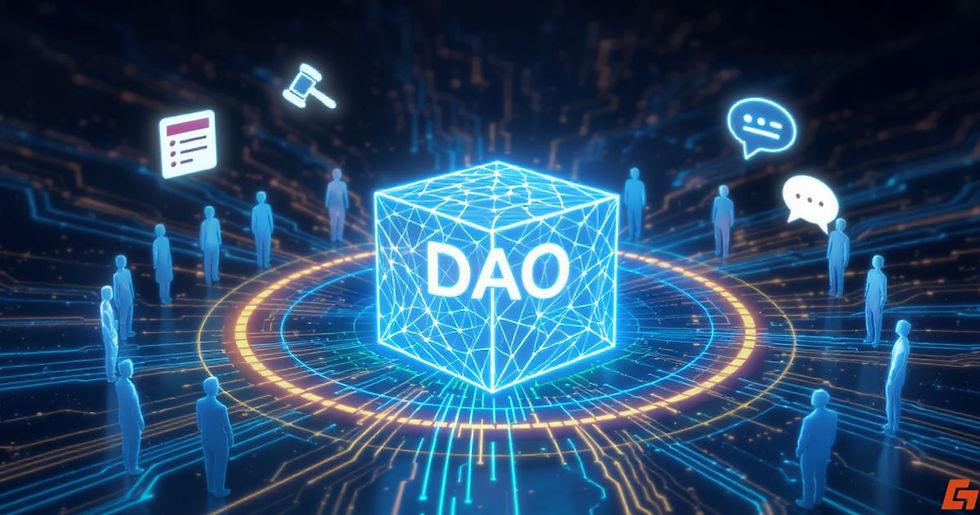
What if companies could run themselves, with no CEO, no managers, and no office politics? That’s exactly what a growing number of internet-native organizations are experimenting with today.
A DAO, or Decentralized Autonomous Organization, is a blockchain-based group governed by smart contracts and community voting, essentially a digital organization without centralized leadership.
DAOs are rewriting the rules of collaboration. From managing billions in decentralized finance to funding global causes overnight, they show us a future where transparency, community ownership, and borderless participation could outcompete traditional institutions.
What You Will Learn in This Article
What a DAO actually is and why it’s different from traditional organizations
How DAOs operate through smart contracts, tokens, and community voting
Examples of DAOs already shaping crypto, from MakerDAO to ENS DAO
Why DAOs matter for transparency, ownership, and global collaboration
The biggest risks DAOs face, from legal grey zones to token “whales”
How you can join an existing DAO, or even launch one yourself
What Is a DAO and Why Everyone’s Talking About It
Let’s start with the basics, what is a DAO? The term stands for Decentralized Autonomous Organization.

At first glance, that might sound like jargon, but it’s really just an internet-native way for people to work together without needing a CEO, manager, or traditional board of directors. Instead of relying on trust in individuals, DAOs rely on code and community.
Smart Contracts: The Rulebook No One Can Bend
The rules of a DAO are baked into smart contracts, which live on a blockchain like Ethereum. These contracts handle everything from how funds are spent to how decisions get approved.
Think of them as the constitution of the group, once written, they automatically execute agreed-upon rules without needing a middleman.
Governance Tokens: Your Digital Voting Rights
Members of a DAO typically hold governance tokens. Owning these tokens isn’t just symbolic, it’s the equivalent of having a voting share in the organization. When proposals are submitted, whether to fund a new project or adjust policies, token holders cast votes.
The outcome isn’t decided behind closed doors, it’s transparent, recorded on-chain, and binding once the smart contract executes.
From Top-Down to Bottom-Up: How DAOs Flip Power Structures
In short, DAOs are digital communities that flip traditional hierarchies upside down.
Instead of decisions flowing from the top down, the community sets the direction, with blockchain tech ensuring the rules are followed.
How Does a DAO Work? Breaking It Down Step by Step
If you’re still wondering how does a DAO work, here’s the breakdown. Everything starts with smart contracts, the backbone of any DAO. These bits of code define the rules and ensure that processes happen automatically.

For example, if a proposal passes with a majority vote, the contract releases funds from the DAO’s treasury, no human approval required.
Token Power: How Votes Shape a DAO’s Future
Members of a DAO hold governance tokens, which function like digital voting shares. Owning tokens isn’t just symbolic, it gives you the right to propose ideas, cast votes, and influence the organization’s future.
The process is transparent: every vote is recorded on the blockchain, visible to all, and impossible to alter after the fact. Unlike shareholder voting in traditional companies, DAO governance happens openly and automatically, with smart contracts enforcing the outcome.
From Ideas to Action: How DAO Proposals Become Reality
Here’s where participation comes in: members submit proposals on platforms like Snapshot or Tally. A proposal could be anything, launching a new product, funding a partnership, or changing the DAO’s structure.
Once submitted, token holders debate, cast votes, and the results automatically take effect.
Who Holds the Money? How DAOs Manage Their Treasury
Finally, there’s treasury management. Instead of being controlled by one person or a small board, funds are collectively owned. The smart contracts ensure that spending only happens when approved by members.
This creates a trustless system where even large sums of crypto can be managed securely, at least in theory.
The DAO Formula: Tech, Tokens, and Community
Put together, DAOs combine blockchain, smart contracts, and community governance into a system that’s transparent, automated, and borderless.
Real DAO Examples That Prove the Concept Works
Now that we’ve covered what is a DAO and how it works, let’s make it more tangible with some real-world examples.

MakerDAO: The Backbone of the DAI Stablecoin
One of the earliest and most influential DAOs, MakerDAO governs the DAI stablecoin, a cryptocurrency pegged to the U.S. dollar.
Token holders decide how DAI is collateralized and maintained, making MakerDAO central to the decentralized finance (DeFi) ecosystem.
Uniswap DAO: A Community-Run Exchange
If you’ve ever swapped tokens on Uniswap, you’ve seen DAO governance in action.
The Uniswap DAO votes on things like fee structures, protocol upgrades and treasury allocation, giving users a real say in how one of the biggest decentralized exchanges evolves.
ConstitutionDAO: When the Internet Tried to Buy History
A short-lived but iconic project, this DAO raised over $40 million in a matter of days to bid on a copy of the U.S. Constitution at auction.
They didn’t win, but the event showed just how fast and powerful DAOs can be at rallying global participation.
ENS DAO: Giving Names to the Blockchain World
The Ethereum Name Service (ENS) is like the domain name system of the blockchain world. Instead of typing long wallet addresses, you can use names like “alice.eth.”
The ENS DAO governs the development, pricing, and policies behind the service, ensuring the community steers its growth.
Beyond Experiments: How DAOs Are Becoming Mainstream
These examples highlight the range of DAO applications, from finance and trading to community-led movements and infrastructure projects.
They also show how DAOs are moving from experimental to mainstream, shaping parts of the crypto landscape that millions of people already use.
Why DAOs Could Change the Way We Work Forever
At this point, you might be thinking: sure, DAOs sound interesting, but why should anyone care? The answer goes beyond the tech, it’s about changing how humans collaborate.

Radical Transparency: Every Vote on the Blockchain
In a DAO, every vote, transaction, and decision is stored on the blockchain for anyone to see. Unlike traditional corporations where boardroom decisions are hidden, DAO governance is open.
If you’ve ever wondered not just what is a DAO but why people are excited about them, transparency is a big part of it.
Community First: Shared Power, Shared Rewards
Members don’t just observe, they participate. The DAO structure ensures that power isn’t concentrated in the hands of a CEO or small executive group.
Instead, governance tokens distribute ownership across a wider group of contributors, aligning incentives more closely with the community’s interests.
Breaking Borders: DAOs as Global Communities
Another powerful aspect is global collaboration. DAOs aren’t restricted by geography, citizenship, or traditional corporate law.
A developer in Argentina can work with a designer in Germany and a marketer in Japan, all contributing to the same DAO with equal voting rights. That kind of borderless teamwork is hard to achieve with traditional models.
Speeding Up Innovation the DAO Way
Finally, DAOs foster faster innovation. Because decisions are made in open, token-based systems, new ideas can be proposed, tested and funded far more quickly than in rigid corporate environments.
Open-source communities thrive under this model, with contributors rewarded directly by the DAO instead of waiting for top-down approval.
The Dark Side of DAOs: Risks You Should Know
Of course, DAOs aren’t flawless. For every success story, there’s also a cautionary tale.

The Participation Problem: When Members Don’t Show Up
One of the biggest challenges is low voter turnout. While many people like the idea of decentralized governance, in practice, only a small fraction of token holders actually vote.
This creates a problem of apathy, DAOs can stall when participation drops.
Code Isn’t Perfect: The Risk of DAO Exploits
There’s also the issue of smart contract bugs. Because DAOs run on code, any mistake can be catastrophic.
A single vulnerability can lock up funds or allow hackers to drain treasuries. We’ve already seen this with “The DAO” hack back in 2016, which led to the infamous Ethereum hard fork.
The Legal Grey Zone: Are DAOs Even Recognized?
Then there’s legal ambiguity. In most countries, DAOs don’t fit neatly into corporate law. Are they partnerships? Co-ops? Something new entirely?
Without clear frameworks, members could be personally liable if things go wrong. While places like Wyoming have introduced legal recognition for DAOs, much of the world is still catching up.
When Big Holders Take Over: The Whale Problem
And let’s not forget whale domination. In theory, DAOs are democratic. In practice, large token holders often have outsized influence.
A single whale wallet can sometimes sway outcomes, undermining the very decentralization that DAOs promise.
Balancing Promise and Peril: A Realistic Look at DAOs
So while DAOs open up exciting opportunities, they also come with risks that communities need to balance carefully.
Want In? How to Join (or Even Start) a DAO
By now, you not only know what is a DAO, but maybe you’re curious about how to get involved. Fortunately, joining one isn’t as complicated as it sounds.

Step 1: Get Tokens, Your Ticket to DAO Membership
The most common entry point is through governance tokens. Many DAOs distribute tokens via exchanges, airdrops, or as rewards for contributions.
Holding these tokens lets you participate in discussions and voting.
Step 2: Join the Conversation on DAO Platforms
Beyond simply owning tokens, active participation happens on community forums and platforms like Snapshot, Discourse, or Tally.
These are where ideas are debated, proposals are crafted, and the groundwork for decision-making takes shape.
Step 3: Propose, Debate, and Vote Like a Member
If you want to go further, you can even suggest new initiatives. Proposals might involve funding new projects, adjusting community rules, or allocating treasury funds.
Every member has the opportunity to shape the direction of the DAO.
Step 4: Launching Your Own DAO With the Right Tools
And if you’re feeling ambitious, you could start your own DAO. Tools like Aragon, DAOstack, and Tally make it possible to set up the technical framework without needing to code from scratch.
From there, it’s about gathering a community, issuing tokens, and defining the purpose of your DAO, whether that’s investing, creating art, supporting charities, or building products.
Getting Started Is Easier Than You Think
DAOs might sound futuristic, but getting involved is often as simple as joining a Discord server, buying a few governance tokens, and raising your voice in the conversation.
The Future of DAOs: Where They’re Headed Next
So, where do DAOs go from here? If the past few years were about experimenting with what’s possible, the next phase is about refinement and scaling.

Smarter Tools Ahead: Making DAOs User-Friendly
One major trend is the rise of DAO tooling. Right now, joining or starting a DAO often requires juggling multiple platforms, forums, voting apps, wallets, and Discord chats.
Over the next few years, expect to see more integrated, user-friendly tools that make participation smoother. If the question starts with what is a DAO, the next natural one is how do I use it without technical hurdles? That’s exactly what these platforms aim to solve.
From Grey Area to Law: Legal DAO Recognition
Another area is legal recognition. Places like Wyoming in the U.S. have already introduced DAO-specific LLC structures, offering a legal wrapper that provides liability protection for members.
As other regions explore similar frameworks, DAOs could transition from “crypto experiments” into legally recognized organizations. This matters for institutional adoption, where compliance and regulation can’t be ignored.
DAOs Everywhere: From Finance to Neighborhoods
We’ll also see DAOs expand into new areas. Today, many focus on DeFi, governance, or protocols, but the future could include investment clubs, charitable funds, creator collectives, and even local community groups.
Imagine a neighborhood DAO that manages shared spaces, budgets, and events, all transparently, with input from every resident.
When Humans and AI Run DAOs Together
Finally, there’s the potential of human–AI collaboration inside DAOs. As AI tools become more capable, they could help moderate forums, analyze voting trends, or even draft proposals.
The idea of AI-assisted governance may sound futuristic, but it’s already being explored in smaller communities.
Looking Ahead: Why DAOs Won’t Stay Niche
The big takeaway? DAOs are unlikely to remain niche.
As technology, regulation and adoption catch up, these organizations could reshape not just crypto, but how people coordinate and govern in digital-first societies.
Are DAOs the Next Big Shift in Governance?
We’ve explored how DAOs work, the opportunities they create, and the challenges they still face. At their core, the answer to what is a DAO is simple: it’s a community-led organization powered by code instead of traditional hierarchy.
They’re not just technical experiments, they represent a shift in how people may coordinate, govern, and share ownership in the digital age. Whether they thrive or stumble will depend on how communities balance transparency, efficiency, and fairness.
So, the real question is this: if power and decision-making can be spread across thousands instead of a handful at the top, would you trust a DAO with your vote, your voice, or even your money?


Comments