

What Is Artificial Intelligence? A Simple Guide That Makes Sense
- Sep 22, 2025
- 12 min read

Artificial intelligence is already deciding what you see online, helping diagnose diseases, and even steering your car.
What is artificial intelligence? Artificial intelligence is the field of computer science focused on building machines and systems that can simulate human intelligence, such as learning, problem-solving, and decision-making.
Whether you’re chatting with a virtual assistant or getting Netflix recommendations, AI is already shaping your daily life. And it’s only accelerating, impacting industries, raising ethical questions, and rewriting how we interact with technology. So if you've ever wondered how it all works, you're not alone and you're in the right place.
What You Will Learn in This Article
What artificial intelligence really means and what it doesn’t
How AI systems learn, make decisions, and process information
The 4 major types of AI, from simple machines to theoretical minds
Where AI shows up in your life, often without you realizing it
What the future of AI could look like and what’s at stake
So... What Is Artificial Intelligence, Anyway?

Let’s cut through the buzz. At its core, artificial intelligence refers to machines that can simulate human-like intelligence, things like learning, problem-solving, recognizing patterns, and even mimicking conversation.
But don’t be fooled: despite how smart it may seem, AI doesn’t "think" the way we do. It follows patterns, probabilities, and data, not gut feelings or intuition.
Not All AI Is Equal: Narrow vs General

Narrow AI: Focused, Fast, and Everywhere
Narrow AI (also called weak AI) is what we interact with today, specialized systems designed to do one task really well.
Think of Siri handling your weather requests or Google Translate converting a phrase from French to English. These tools may feel magical, but they’re actually pretty limited in scope.
General AI: Still a Fantasy (For Now)
General AI, on the other hand, is still science fiction. That would be a system with human-like reasoning across multiple domains.
It's something that could learn to write a poem, diagnose a patient, and then negotiate a contract, all in one sitting. We’re nowhere near that yet.
Why AI Doesn’t "Understand" Like We Do
And just to clear the air: what is artificial intelligence isn’t the same as asking “what makes us human.” AI can mimic, predict, and generate, but it doesn't understand.
Tools like ChatGPT might carry a fluent conversation, but they’re working off statistical patterns, not true comprehension.
How Does AI Actually Learn, Think, and Decide?
So, how does a machine “learn” to recognize a cat, suggest a movie, or answer your questions? It all starts with data, massive amounts of it.
AI systems are built on three main ingredients: data input, algorithms, and decision-making models.
The Ingredients Behind AI: Data, Logic, and Models

Data: The Fuel That Powers It All
Think of data as the raw ingredients. It might be photos, emails, GPS locations, or sales reports, whatever the AI is being trained to understand.
Algorithms: The Rules of the Game
Algorithms, then, are the recipes. They process that data in specific ways, looking for patterns, connections, and rules.
Models: Where Learning Turns Into Action
And finally, decision-making models are the finished dish, how the system responds or acts based on what it’s learned.
Training vs Inference: Learning vs Doing
Now here’s where it gets interesting: there are two major phases in an AI system’s life, training and inference.

Training AI Is Like Raising a Kid, Sort Of
Training is like teaching a child. You show it thousands (or millions) of examples. A model might see millions of images labeled “dog” or “not dog” until it gets good at recognizing the difference.
Inference: When AI Starts Thinking on Its Feet
Inference is what happens after training, when the AI is set loose in the world and starts making decisions based on what it learned.
AI Isn’t Magic, It’s Just Really Fast Math
Imagine teaching a kid to recognize fruits. You give them apples, oranges, bananas, until they get the hang of it.
Then you ask them to identify something new. That moment, when they say “banana!” with confidence? That’s inference. That’s AI doing its thing in the real world.
And no, it’s not magic. It’s math, data, and an absurd number of calculations per second.
The 4 Levels of AI: From Chess Bots to Sci-Fi Minds
Let’s break down the different “levels” of AI. Not all artificial intelligence is created equal, and understanding the types helps make sense of what’s already here and what’s still just theory for now.

Reactive AI: Instant Decisions, Zero Memory
These are the simplest form of AI. They don’t “remember” anything. They just react to current inputs.
IBM’s Deep Blue, the chess-playing computer that beat Garry Kasparov in the '90s, is a classic example. It could analyze moves but had no memory of past games.
Limited Memory AI: Learning Just Enough to Adapt
Most modern AI falls into this category. These systems can use historical data to make decisions.
Think self-driving cars, they use past observations (like speed, position, and lane markers) to navigate the road in real time. Still, their memory is limited and purpose-specific.
Theory of Mind: The AI That Could Read You
This level doesn’t exist yet, but it’s where machines would begin to understand human emotions, beliefs, and intent.
In other words, a machine would need to grasp that you’re upset not because your Wi-Fi is down, but because you have a work deadline. We’re not there yet and maybe that’s a good thing.
Self-Aware AI: The Sci-Fi Stuff (For Now)
Now we’re deep in sci-fi territory. This would be a machine with its own consciousness. A sense of self.
It would understand its existence and maybe even have opinions. As of now, this is theoretical and hotly debated. Some argue we shouldn’t ever go this far.
What Exists and What’s Still Just Theory
Understanding these types helps frame the broader question: what is artificial intelligence in practice vs theory?
Right now, we’re still working with narrow systems and limited memory. The rest? They’re still scribbled on whiteboards in research labs (and occasionally used in plot twists for Hollywood thrillers).
Everyday AI: Real Tools You’re Already Using
Okay, theory’s great, but what does artificial intelligence look like out in the wild? Chances are, you’ve already interacted with it today, maybe without even realizing.
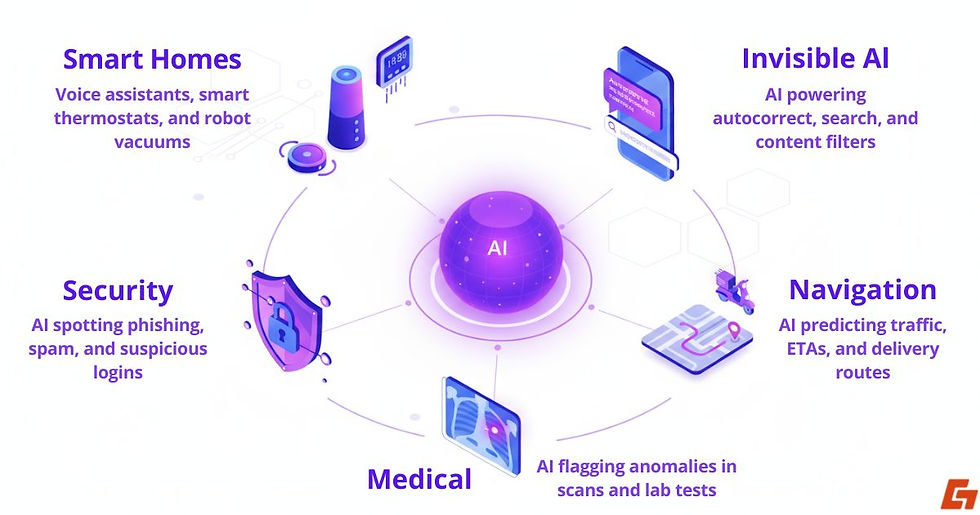
Smart Homes, Smarter Voices: AI All Around You
Smart devices like thermostats that learn your habits, robot vacuums that map your floors, or voice assistants like Alexa and Google Assistant all run on AI.
They're not just convenient, they're context-aware, responding to preferences and environmental cues.
AI in Security: Protecting You in the Background
AI also plays a huge role in digital security. Think beyond spam filters, AI helps detect phishing emails, flag risky login attempts, and even predict cyberattacks by analyzing behavioral patterns across networks.
These systems protect your data quietly in the background.
Medical AI: Helping Doctors Catch What Humans Miss
In hospitals and labs, AI is scanning x-rays, flagging anomalies in bloodwork, and even helping detect early signs of cancer.
Tools like IBM Watson Health or Google's DeepMind are being used to support diagnoses, not replace doctors, but give them a second set of “eyes.”
AI on the Move: Maps, Delivery, and Traffic Predictions
When your GPS reroutes to avoid traffic or a food delivery app predicts your ETA down to the minute, that’s AI in action.
These systems digest real-time data to make logistics smoother, not just for companies, but for everyday users trying to get home faster.
Invisible AI: Behind the Scenes in Everyday Apps
From autocorrect in text messages to content moderation on social platforms, AI is working invisibly behind the curtain.
Even Google Search itself runs on layers of AI to predict what you meant, even when you misspell half the query.
Why These Everyday AI Uses Actually Matter
These examples highlight the everyday reach of AI. So when someone asks, what is artificial intelligence, the answer isn’t just “something futuristic.”
It’s already everywhere, shaping experiences, protecting users, and operating quietly behind the scenes.
Why Is AI Evolving So Quickly and What’s Fueling It?
It seems like every week there’s a new AI model, app, or scandal. So why now? What’s fueling this rapid acceleration?

More Data, Smarter AI: The Feedback Loop
First and foremost: data. We’re generating more of it than ever, photos, texts, purchases, health stats, even how long you pause before clicking a video.
This ocean of information is the fuel that powers machine learning models. The more data an AI system can train on, the better (and faster) it learns.
The Hardware Boom That’s Driving AI Forward
Then there’s computing power. Back in the day, training an AI model might’ve taken months on slow processors. Now? Thanks to specialized chips like GPUs and TPUs, models can train in hours or even minutes.
It’s the difference between writing a novel by hand and using a high-speed printer, it changes the game entirely.
Open-Source AI: Building Blocks for Everyone
Another big factor is the explosion of open-source AI libraries like TensorFlow and PyTorch. These platforms made building AI tools far more accessible, no need to reinvent the wheel each time.
Anyone with some Python skills and a laptop can tinker with machine learning, which has democratized experimentation like never before.
Why Businesses Are Betting Big on AI
And of course, businesses have noticed. From chatbots in customer service to AI-driven analytics, the potential for automation and cost savings is enormous.
Companies are racing to integrate AI not just because it’s trendy, but because it improves performance, cuts labor, and gives them a competitive edge.
So Why Is AI Advancing Right Now?
In short, what is artificial intelligence in 2025? It’s a snowball gaining speed, pushed by data, powered by silicon, and fueled by economic incentives.
AI Isn’t What You Think: Busting the Biggest Myths
Let’s clear the air. There’s a lot of noise around AI, and not all of it’s accurate. So before we move forward, let’s address a few of the most common myths.

Myth: AI Understands You (It Doesn’t)
Nope. It’s easy to think ChatGPT or your smart speaker “understands” you, but that’s an illusion.These systems can predict your next word or recognize your voice, but they don’t feel, think, or have self-awareness.
They’re predictive, not perceptive.This is one of the most persistent misunderstandings about what is artificial intelligence, and it’s fueled by how natural these tools feel in conversation.
Myth: AI Will Steal Every Job
Then there’s the panic-button belief that AI is coming for everyone’s job.The truth is more nuanced. Yes, AI will automate certain tasks, especially repetitive, data-heavy ones.
But it will also create new roles in areas like AI training, ethics, data labeling, prompt engineering, and system design.
Think of it less like a robot stealing your job and more like a shift in the job market. That said, some roles will become obsolete, and that’s a real challenge we’ll need to address.
Myth: AI Is More Objective Than Humans
Another popular myth? That AI is somehow more objective or always right. Not exactly. AI can be shockingly smart, but it’s only as good as the data it’s trained on.
Biases in hiring models, medical tools, or sentencing algorithms have already caused real harm. AI doesn’t magically eliminate human flaws; it can amplify them if we’re not careful.
How Sci-Fi Warps What We Think AI Can Do
So, if you’re asking, “what is artificial intelligence” and getting wildly different answers, it’s probably because too many people are basing their understanding on sci-fi rather than science.
What AI Does Well (So Far): Speed, Accuracy, and Insight
Let’s shift the focus from where AI is used to why it’s being adopted so quickly. Across industries and use cases, artificial intelligence is delivering measurable outcomes.

AI Works Fast, Really Fast
AI excels at doing things faster than any human ever could, without burnout, breaks, or bottlenecks.
Whether it's scanning thousands of legal documents or analyzing real-time sensor data from a factory floor, AI can operate at a scale that human workers simply can’t match.
When AI Gets It Right (And Why It Matters)
From fraud detection to medical diagnostics, AI is helping reduce errors and catch what people might miss.
Unlike a tired analyst or overworked technician, AI doesn’t blink or zone out, it identifies patterns and anomalies with striking consistency.
Helping Humans Decide, Without Taking Over
AI supports high-stakes decisions by offering data-backed insights. It’s not about replacing judgment, it’s about enhancing it.
Executives use AI for forecasting, doctors use it for second opinions, and marketers use it for campaign targeting based on actual user behavior.
Millions of Users, One Experience Each
This is where AI truly shines for users, adapting services to individual needs. From e-commerce recommendations to personalized learning platforms.
AI customizes experiences for millions of people simultaneously, based on behavior and preferences.
AI Handles the Tedious Stuff So You Don’t Have To
AI helps teams automate the repetitive stuff: tagging images, sorting emails, generating reports, and more.
That frees up humans to focus on strategic, creative, and interpersonal work, where we still outperform machines.
AI Isn’t Here to Replace You, It’s Here to Assist
Of course, AI has limitations. It's only as good as the data it learns from and mistakes do happen.
But when implemented with care, it’s less about replacing jobs and more about amplifying human potential.
The Dark Side of AI: Bias, Privacy, and the Black Box
Now let’s talk about the flip side, the stuff that keeps researchers, regulators, and everyday users up at night.

When AI Learns the Worst of Us
The first big one? Bias.
AI models are trained on historical data. And that data often reflects the flaws of our world, racial bias, gender inequality, socio-economic gaps.
So if an AI system is used in hiring or law enforcement, those biases can sneak in and scale up. That’s a scary prospect, and it’s already happened in real life.
Privacy and AI: How Much Does It Know?
Then there’s data privacy.
AI systems need huge datasets to learn. But where does that data come from? Who owns it And what happens when AI is scraping your conversations, photos, or habits to improve itself?
If you’ve ever asked yourself, “Am I being watched right now?” you’re not alone.The line between smart tools and creepy surveillance gets thin fast.
Black Box AI: The Mystery Inside the Machine
Another issue is the infamous black box problem.
Many AI models, especially deep learning ones, can’t explain why they made a certain decision.
You ask it to approve a loan or diagnose a disease, and it gives you an answer, but no reasoning.That lack of transparency creates accountability problems. It’s hard to trust a system you can’t understand.
Fake News, Fake Voices: AI’s Role in Misinformation
And then we have misinformation.
Deepfakes, AI-generated articles, synthetic voices, they’re getting better and harder to detect.
The same tech that powers virtual assistants can also fake a political speech or scam your grandma.
Forget What AI Can Do, Ask What It Should Do
So while it’s exciting to ask, “What is artificial intelligence doing next?”,it’s just as important to ask, “What should it be allowed to do?”
What’s Coming Next for AI: Smarter Tech, Bigger Questions
We’ve covered what artificial intelligence is and how it’s reshaping the world, but where is it all heading?

General AI: The Dream (and the Debate)
Let’s start with the big idea: General AI.
That’s the hypothetical form of intelligence that can perform any intellectual task a human can. We’re not there yet.
Today’s systems are still narrow, built for single tasks.But researchers are racing toward something more flexible, something that doesn’t just answer questions but learns across domains, adapts on the fly, and maybe even reasons in ways that feel familiar.
Rules for Robots: Who Keeps AI in Check?
As that pursuit continues, so does the push for ethical guidelines and regulation.
Governments, academics, and tech companies are all grappling with the same question: How do we build AI that’s powerful but safe?
That respects rights, avoids harm, and doesn’t spiral into unintended consequences?
The stakes are high, and the answers aren’t simple.
Edge AI: Making Smarter Gadgets Smarter
Meanwhile, AI is also moving closer to the edges of our daily lives, literally.
Think IoT (Internet of Things) devices: smart thermostats, voice-controlled ovens, wearables that monitor your vitals.
AI is powering more of these gadgets, and as edge computing becomes more common, those devices won’t need to send data to the cloud, they’ll make decisions right there, on the spot.Faster, smarter, more responsive.
The Future of AI? It’s Already in Your Fridge
So, what is artificial intelligence going to look like in five years? Or ten? It’s hard to say. But one thing’s for sure, it won’t be limited to apps and websites.
It’ll be in your home, your car, your doctor’s office, and maybe even your fridge.
Why Understanding AI Starts with the Basics
We’ve unpacked the basics of how AI works, the types of systems that exist, where it’s showing up in everyday life, and the real benefits and concerns it brings. Hopefully, what once felt abstract now feels a little more concrete.
Understanding what is artificial intelligence isn’t just about tech, it’s about recognizing how our world is evolving and how we’re shaping it in return. The smarter our tools get, the more intentional we have to be about how we use them.
So what do you want your relationship with AI to look like, passive observer, or informed participant? The future's already in motion, and learning is your first move.


Comments