

What Is Natural Language Processing? How It Actually Works
- Oct 2, 2025
- 10 min read

Ever wonder how Siri understands your voice, or how ChatGPT can respond like it’s actually listening? Behind every smart reply is a complex system trying to decode your words the way a human would.
Natural language processing is the field of artificial intelligence that enables machines to understand, interpret, and generate human language in a way that's both meaningful and useful.
Language is messy, emotional, and packed with nuance and yet, AI is getting scarily good at keeping up. As NLP becomes the backbone of tools we use every day, from search engines to chatbots, understanding how it works isn’t just for techies anymore. It’s shaping the way we interact with the world.
What You Will Learn in This Article
What Does Natural Language Processing Actually Mean?
Natural Language Processing, or NLP for short, is where computers begin to understand us, not just the cold, rigid logic of code, but the messy, beautiful complexity of human
language.

It’s not simply about converting text into data; it’s about teaching machines how we speak, how we write, and even how we feel.
NLP Is the Language Bridge Between Humans and Machines
At its heart, natural language processing sits at the intersection of computer science, linguistics, and artificial intelligence. Imagine a three-way handshake between grammar rules, statistical patterns, and machine logic.
The ultimate goal? To help machines interpret what we say, respond like they understand us, and even generate language that feels natural, sometimes eerily so.
Core Building Blocks of Human Language Understanding
Syntax
The rules that govern sentence structure. Think subject-verb-object.
Semantics
The actual meaning of the words and phrases.
Context
The surrounding words and situations that shape meaning.
Tone and Intent
The emotional layer beneath the words (like when “fine” doesn’t actually mean fine).
When You Talk, NLP Is Listening
So, whether you’re texting your phone or yelling at your smart speaker for mishearing you again, there’s a system behind the scenes working hard to decode what you actually meant.
How Does NLP Work Behind the Scenes?
Okay, so how does NLP actually work? Spoiler: it's not magic, though sometimes it feels like it. There’s a series of foundational steps and models that help machines make sense of language, piece by piece. Kind of like a child learning to read, one layer at a time.

Step by Step: How Machines Start Understanding Language
Tokenization – Breaking Language Into Pieces
This is where it all starts. The system breaks down a sentence into individual words or “tokens.” For example, “I love pizza” becomes [“I”, “love”, “pizza”].
Simple? Maybe. But in languages without spaces (like Chinese), tokenization gets way more complex.
Part-of-Speech Tagging – Labeling Each Word’s Role
Once we have the words, machines need to figure out what each one is. Is “run” a verb or a noun? Depends on the sentence.
Part-of-speech tagging helps systems understand the role each word plays. This is where natural language processing in AI starts flexing its pattern-recognition muscles.
Parsing and Syntax Trees – Mapping Sentence Structure
Parsing is how machines understand sentence structure. Think of it like diagramming a sentence back in grade school, only way more advanced.
Syntax trees map relationships between words so the machine sees not just what’s said, but how it's constructed.
Named Entity Recognition (NER) – Spotting Real-World Stuff
This one's all about pulling out real-world references: names, dates, brands, cities, you name it.
So when a system reads, “Barack Obama was born in Hawaii,” it recognizes “Barack Obama” as a person and “Hawaii” as a location.
Sentiment Analysis – Understanding Emotions in Text
Here’s where things get emotional. Literally. Sentiment analysis tells machines if the text is positive, negative, neutral, or even sarcastic (though sarcasm still throws a wrench in the works).
It’s the tech behind those “How did we do?” surveys and brand monitoring dashboards.
Putting It All Together: From Words to Meaning
When all of these components work together, machines don’t just read our words, they begin to grasp the meaning behind them.
It’s a layered process, and each step brings us closer to making AI feel like it’s actually listening.
The Real Power Behind NLP: Machine Learning
Now we get to the brainpower behind it all: machine learning. This is what makes NLP not just rules-based, but adaptive. It’s how systems improve over time, learn from data, and sometimes surprise even their creators with what they can do.

The Three Core Approaches That Make NLP Smarter
Supervised Learning – Teaching With Examples
This is the textbook method. Feed the system a huge dataset of labeled examples, like emails marked “spam” or “not spam” and let it learn the patterns.
Over time, it starts recognizing those patterns in new, unseen data. It’s precise, but it needs a lot of prep work (read: human effort).
Unsupervised Learning – Letting the AI Discover on Its Own
This one’s a little wilder. Instead of labels, the system looks for patterns all on its own. Topic modeling is a good example
Given a bunch of news articles, it might start grouping them into clusters: politics, sports, tech, without ever being told what those categories are. Creepy? Maybe. Impressive? Definitely.
Deep Learning and Transformers – Where NLP Truly Shines
Here’s where natural language processing in AI really takes off. Deep learning models, especially transformers like BERT and GPT, have revolutionized NLP.
These systems are trained on massive datasets (we’re talking billions of words) and learn to predict what comes next in a sentence. That might sound basic, but it enables everything from autocomplete to full-blown conversational AI.
Neural networks mimic the way our brains process information, layered, interconnected, and constantly adjusting. And with transformer architecture, machines don’t just look at words one by one. They understand context. They remember what was said ten sentences ago. They’re not just reacting; they’re comprehending.
It’s the difference between a parrot repeating words and a friend who actually gets what you’re saying.
How You Already Use NLP (Even If You Don’t Know It)
Here’s the thing, even if you’ve never heard the term before, you’ve definitely used natural language processing. It’s behind so many tools we rely on daily that it’s easy to take it for granted.
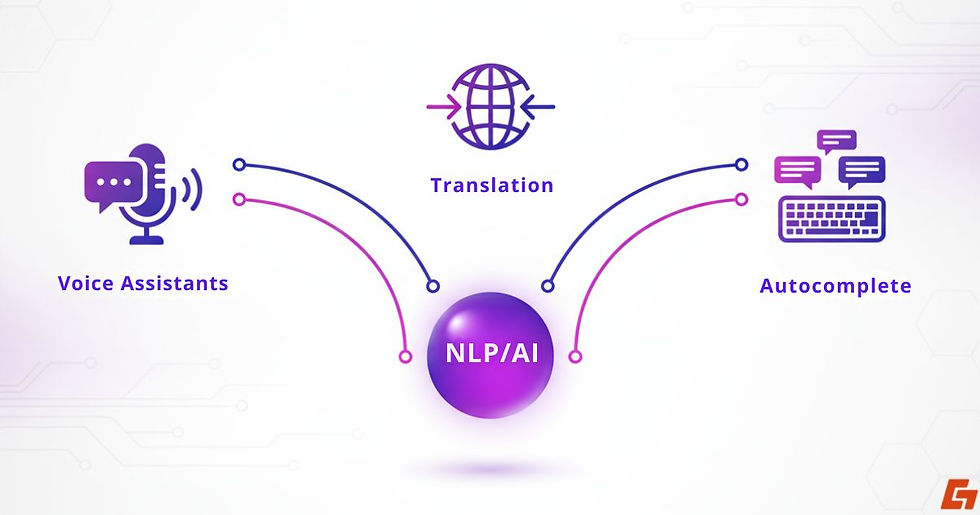
Your Voice Assistant? That’s NLP in Action
Ever talked to a virtual assistant? That’s NLP. When you ask Siri, “What’s the weather like in Rome?” the system’s not just picking out keywords.
It’s analyzing your sentence structure, identifying intent, pulling out the location, and spitting out an answer that (hopefully) makes sense. Same goes for Alexa and Google Assistant, they live and breathe NLP.
Machine Translation Has Leveled Up
And let’s not forget real-time translation tools like Google Translate or DeepL. A decade ago, machine translations were… let’s say, “creative.”
But now? They’re surprisingly accurate and only getting better, thanks to continuous improvements in NLP models.
Everyday Tools Powered by NLP
Spam Filters
They don’t just spot spammy keywords, they understand the tone and topic of an email.
Autocorrect & Predictive Typing
They anticipate what you meant, even when your thumbs totally betray you.
Customer Support Chatbots
They answer FAQs and help troubleshoot with surprisingly human-like responses.
Smart Replies
They generate quick, relevant responses in apps like Gmail and LinkedIn.
SEO & Writing Tools
They summarize, rephrase, or optimize text by recognizing common language patterns.
It’s Everywhere, You Just Don’t See It
Basically, if a tool is dealing with human language and making decisions based on it, there’s NLP working quietly in the background, parsing, tagging, learning, and responding.
NLP at Work: How Businesses Quietly Rely on It
If you thought NLP was just about making life easier for the average user, buckle up. Behind the scenes, natural language processing is transforming how entire industries operate.

It quietly automating, analyzing and accelerating tasks that used to take humans hours or even days.
Legal and Medical Fields: From Paperwork to Productivity
Let’s start with legal and medical fields. Document-heavy industries used to drown in paperwork. Now, NLP algorithms can auto-summarize contracts, extract critical terms, or generate medical transcriptions with a high degree of accuracy.
Less time reviewing documents means more time focused on actual decision-making.
Marketing and CX: Understanding What Customers Really Say
In customer experience and marketing, companies use NLP to monitor thousands of reviews or social media posts in real time.
They’re not just counting stars, they’re analyzing tone, flagging common complaints, and even spotting potential PR disasters before they explode.
Finance: Pattern Recognition Beyond Numbers
Then there’s finance, where fraud detection systems use NLP to spot suspicious language in claims or transactional notes. It’s not just about numbers anymore, it’s about language patterns, too.
More Ways NLP Is Reshaping Workflows
Auto-Generated Reports
Creating readable summaries from raw, unstructured business data.
Voice-to-Text Tools
Used in enterprise environments for fast, accurate dictation.
Compliance Monitoring
Analyzing internal communications for violations or risky language.
Financial AI Assistants
Answering investor questions in real time, using natural language understanding.
Even HR Is in on It
And here’s a fun twist: some HR departments are even using NLP to scan résumés and match candidates based on phrasing patterns and qualifications. Yes, your word choice really does matter.
The Flaws in the System: Where NLP Still Struggles
Now, before we go singing endless praise, let’s be real, natural language processing still has its quirks. And some of them? They're not easy to fix.

Ambiguity: When Words Have Too Many Meanings
First up: ambiguity. Humans are masters of being vague. “I saw her duck”, did she crouch, or did a bird fly by? Machines struggle with this kind of thing because they lack common sense (and context).
We don’t realize how much background knowledge we use to understand a sentence until a machine totally fumbles it.
Sarcasm and Slang: Still Way Too Human
Then there’s sarcasm. You say, “Great job!” after someone messes up, a human hears the tone and rolls their eyes. A machine? It might just log that as positive sentiment. Same with slang, regional dialects, and emoji-filled messages.
We speak in a thousand tiny variations, and NLP systems can’t always keep up.
More Lingering Issues Holding NLP Back
Multilingual Complexity
Different grammar rules, expressions, and cultural references make training models across languages extremely complex.
Bias in the Data
If you train an AI on biased or unbalanced content, it will replicate those patterns, sometimes with disastrous results.
Emotional Intelligence Is Still Lacking
Machines still struggle with subtlety, especially when tone or context shifts mid-sentence.
Misinformation Amplification
NLP models can unintentionally spread false narratives if they're not carefully trained and filtered.
Close… But Still Not Quite Human
Even with all the progress made, NLP still lacks a truly human grasp of nuance. And until that gap narrows, there’ll be moments where your smart assistant still doesn’t “get it”, no matter how many times you repeat yourself.
From Scripts to Sentience? A Brief History of NLP
If you think natural language processing just popped up overnight, think again. It’s been decades in the making and the journey’s been, well, kind of weird and wonderful.

The 1960s: Chatbots Before the Internet
Let’s rewind to the 1960s. One of the earliest attempts at NLP was a chatbot named ELIZA, built at MIT. It mimicked a psychotherapist by rephrasing user input.
Say something like “I’m feeling sad,” and ELIZA would respond with “Why do you feel sad?” It seemed clever, but it didn’t actually understand anything. It just followed a script.
The Rule-Based Era: Lots of Logic, Little Flexibility
From there, we moved into rule-based systems. These were basically a giant list of "if-this-then-that" instructions, very rigid, very brittle.
They worked okay for specific tasks but fell apart the second language got too flexible or informal. Which, you know, is always the case with humans.
The 1990s: Enter Statistical Models
The game changed in the 1990s with the rise of statistical models. Instead of hand-coding rules, researchers started feeding computers tons of text and letting them learn patterns.
Suddenly, systems weren’t guessing based on rules, they were predicting based on probability. Translation, summarization, even search engines got a serious upgrade.
Today’s Breakthroughs: Deep Learning and Transformers
But the real breakthrough? That came with deep learning and transformers. Tools like BERT, GPT, and T5 took things to a whole new level.
These models didn’t just look at individual words; they looked at context, relationships, and even sentence position to figure out what you meant. That’s how we ended up with tools that can write articles, compose emails, or chat like a real person (well… almost).
From ELIZA to GPT: It’s Been a Journey
NLP has come a long way from ELIZA’s pre-programmed scripts to GPT’s predictive language generation. And it's still moving fast, faster than most people realize.
What’s Next for NLP? A Glimpse Into the Near Future
So where do we go from here? If the current pace is anything to go by, natural language processing in AI isn’t just improving, it’s evolving into something borderline uncanny.

Future Frontiers That Are Already in Motion
Emotionally Aware AI – Understanding Not Just Words, But Feelings
We’re already dabbling in sentiment analysis, but future NLP systems may take it further, recognizing not just emotions like anger or joy, but subtle cues like frustration, hesitation, or sarcasm. That’s the dream: machines that get us, mood swings and all.
Real-Time Multilingual Translation – Killing the Language Barrier
Think universal translators, not just accurate, but instant. We’re talking about real-time voice translation in group meetings, cross-border video calls, even tourism. The goal? Make language barriers a thing of the past.
Smarter Voice Assistants – Conversations That Actually Flow
Right now, voice assistants are handy but kind of forgetful. Future versions could maintain longer conversations, remember preferences, or shift topics naturally, all thanks to stronger natural language processing in AI.
NLP in AR/VR – Talking to the Digital World
As augmented reality becomes more mainstream, we’ll need ways to talk to those systems and gestures alone won’t cut it.
NLP will likely become the core interface, allowing users to interact using plain language in 3D environments.
What’s Fueling the Leap Forward?
What’s driving all this? Two things: more data and better models. As transformers get more sophisticated and compute power grows, we’re inching closer to an AI that doesn’t just decode language, it truly understands it. Or at least bluffs really, really well.
The Future Speaks Human and AI Is Listening
From the basics of machine understanding to real-world tools like chatbots and translators, we’ve explored how natural language processing bridges the gap between human communication and machine logic.
It’s not just a technical breakthrough, it’s a shift in how we live, work, and connect with technology that seems to understand us a little better every day.
So next time your phone finishes your sentence or a support bot actually solves your problem, take a second to wonder: how much do these machines really understand and how far will they go?


Comments