

How Does an AI Chatbot Actually Work? Here’s What to Know

Ever messaged customer support and thought, Wait... was that even a real person? You're not alone and you probably just chatted with an AI.
An AI chatbot is a conversational program powered by artificial intelligence that can understand, respond to, and learn from human language in real time, via text or voice.
As more of our lives move online, AI chatbots are quietly transforming how we interact with businesses, services, and even education. They’re fast, available 24/7, and surprisingly, getting more human by the day. But how do they actually work, and can they really replace people in meaningful ways?
What You Will Learn in This Article
Not All Chatbots Are Created Equal
Let’s clear the air: not every chatbot is an AI chatbot.

You've probably talked to those robotic little boxes that repeat the same menu no matter what you type. That’s a scripted or rule-based chatbot, it follows a fixed path, like an automated phone menu. No learning, no adapting, just: “Press 1 for this, type yes for that.”
So What Makes a Chatbot Actually “Smart”?
An AI chatbot, on the other hand, behaves more like a digital conversationalist. It understands your intent, not just your words. You could say the same thing five different ways, and it’ll (hopefully) get what you mean each time.
The Tech Behind the Talk
These chatbots are powered by artificial intelligence, mainly natural language processing and machine learning, so they can interpret what you're asking, pull relevant information, and even adjust based on context.
Meet Virtual Agents: The Grown-Up AI Chatbots
Then there are virtual agents, the older siblings of AI chatbots. These are the ones integrated into customer support teams, HR departments, or even virtual banks.
They Don’t Just Chat, They Act
They’re not just answering questions, they're fetching account details, scheduling meetings, and handing off to humans when things get tricky. Unlike basic bots, virtual agents often maintain short-term memory, so they don’t lose track mid-conversation.
So, in short: regular chatbots follow scripts. AI chatbots think on their feet. Virtual agents? They're out there solving problems and sounding shockingly human while they do it.
What Really Powers an AI Chatbot? It’s Not Just “Magic”
So how do these bots manage to sound semi-human, answer obscure questions, or sometimes even make jokes that actually land?

It all comes down to the tech beneath the hood. The magic of an AI chatbot doesn’t happen in a vacuum, it’s built on a few foundational components that make everything click.
Natural Language Processing: Teaching Bots to Understand Us
Natural Language Processing (NLP) is where it starts. This is the part that lets a machine understand your words, not just as text, but as meaning. NLP breaks down grammar, intent, tone, even slang (well, most of the time).
It's why you can say “I’m freezing in here!” and the AI knows you're cold, not asking about cryogenics.
Machine Learning: The Memory That Makes Bots Smarter
Next up: Machine Learning (ML). Think of this as the brain's memory system. Every time you chat with a bot and it figures out the right answer, or the wrong one, it learns.
Over thousands (or millions) of conversations, the AI chatbot improves, identifying patterns and refining its responses. It's why bots from major companies feel smarter now than they did even six months ago.
Speech Recognition: When Chatbots Learn to Listen
Speech Recognition plays a big role too, especially with voice assistants like Alexa or Google Assistant. These systems convert spoken language into text, which the bot can then process using the same NLP and ML tools.
Voice adds complexity, accents, speed, background noise, but it’s increasingly accurate.
APIs and Integrations: Connecting the Bot to the Real World
And then you’ve got the integration layer, a set of APIs that connects the chatbot to other tools: customer databases, support ticket systems, calendars, CRMs.
That’s how a virtual agent can check your order status or cancel your flight without ever involving a human. Seamless? Sometimes. Impressive? Absolutely.
Types of AI Chatbots: Not All Bots Are Built Alike
AI chatbots don’t all come from the same mold. Some are glorified FAQ tools. Others? Basically mini-coworkers. Let’s unpack the types, because the range is wider than most people think.

Rule-Based Bots: Predictable, but Not Very Smart
These are the simplest form. Think of them as a branching tree, if you say A, it replies with B. There's no actual “thinking” going on. They're great for predictable tasks, like answering store hours or checking account balances, but hit a wall fast if you ask anything unexpected.
They’re often mistakenly labeled as AI chatbots, but don’t be fooled: there’s nothing “intelligent” going on behind the scenes.
Smart AI Chatbots: The Bots That Actually Learn
Now we’re talking. These bots use machine learning to analyze input, infer intent, and generate responses on the fly. They adapt. They learn from feedback. The more conversations they have, the better they get.
Smart AI chatbots are commonly used in support desks, online shopping assistants, and even some mental health apps. They’re still bots, but they feel a lot more like actual conversation partners.
Voice-Based Agents: When AI Finds Its Voice
These are the voices in your smart speakers, your phone, your car dashboard. Voice-based AI chatbots combine speech recognition with NLP and synthesis (turning text back into speech).
Siri, Alexa, and Google Assistant are the poster children here. What’s fascinating is how these agents are beginning to “remember” preferences, your favorite playlists, your commute times and adjust behavior accordingly.
In reality, most companies use a mix: rule-based for the basics, AI-powered for flexibility, voice for hands-free interaction. And as the tech matures, those lines are starting to blur.
Where AI Chatbots Are Quietly Doing the Heavy Lifting
It’s easy to think of AI chatbots as novelty tools, cool tech that mostly lives inside marketing slides. But in reality? They’re quietly everywhere. Businesses big and small are using them to handle the stuff that used to clog inboxes and tie up phone lines.

Customer Support: No More Waiting on Hold
Let’s start with customer support. From banks to e-commerce giants, AI chatbots are answering basic questions, resetting passwords, and even walking people through refunds, without anyone waiting on hold.
These bots are built to handle the repetitive (and frankly boring) stuff, freeing up human agents for more complex issues.
Healthcare: Virtual Agents With a Bedside Manner
In healthcare, AI-driven virtual agents are acting as symptom checkers. They ask you what’s wrong, suggest possible causes, and even help schedule appointments.
Sure, they’re not diagnosing cancer, but they’re a decent first step when you don’t know whether it’s just a cold or something nastier.
Education: AI-Powered Tutors That Never Get Tired
Education’s getting a chatbot upgrade too. Virtual tutors now help students practice math problems, learn new languages, or prep for exams, all personalized to how the student learns best.
These AI tools track progress, adjust difficulty, and even encourage when motivation drops.
Behind the Scenes: IT and HR Support You Don’t See
Even behind the scenes, AI chatbots are making life easier. Think internal IT helpdesks or HR bots that onboard new hires, track PTO, or walk employees through benefits.
These virtual agents are like helpful coworkers who don’t get tired, annoyed, or take lunch breaks.
Retail and Lead Generation: Chat That Sells Without Being Pushy
And let’s not forget retail and lead generation. Ever landed on a site and had a chatbot ask if you needed help? That wasn’t just polite design, it was a lead funnel.
AI chatbots are qualifying customers, recommending products, and nudging users toward checkout before a human even steps in.
So yeah, they’re not just answering “What time do you close?” anymore.
How AI Chatbots Actually Learn (Spoiler: It’s Not Magic)
It might seem like these bots just know things out of the box. But truth is, an AI chatbot only becomes useful after a whole lot of learning, just like a new employee who starts clueless and gets smarter over time.

Step One: Train the Bot Like a Binge-Watcher
Most start with training datasets, massive archives of past conversations, FAQs, or even customer complaints. These datasets teach the AI patterns: what people typically ask, how they phrase it, what responses work.
It's kind of like binge-watching every episode of customer service interactions ever recorded, over and over, until the patterns stick.
Step Two: Learn by Doing (and Failing a Bit)
Then there’s reinforcement learning, where the system gets better by doing. After each interaction, it gets feedback, maybe directly from users (“Was this helpful?”), or indirectly through behavior (Did the customer bounce? Did they follow through?).
Good choices are reinforced; bad ones get weeded out.
Step Three: Human Guidance Still Matters
Over time, the AI starts to fine-tune its responses, tone, and even timing. But here’s the catch: it’s not left alone to figure it all out.
There’s usually a human-in-the-loop guiding the process, refining prompts, tweaking the dataset, or stepping in when the bot hits a wall. This is where prompt engineering enters the picture, crafting the right instructions so the bot responds the way you want.
Learning Never Stops and That’s a Good Thing
The learning never really stops. As language evolves and customer expectations shift, AI chatbots have to keep pace. That’s why modern systems are often updated monthly (or even weekly), based on fresh data.
So, if you've ever wondered why a chatbot suddenly seems "smarter" than it was last week, it probably is.
Why Businesses Love AI Chatbots and Users Kinda Do Too
Let’s be honest, people used to hate chatbots. They were stiff, frustrating, and felt like a digital dead end. But with smarter systems, especially AI chatbots that can actually hold a decent conversation, that perception is changing fast.

Always On: 24/7 Help Without the Coffee Breaks
From a business perspective, the benefits are hard to ignore. First and foremost: they don’t sleep. AI chatbots are available 24/7, answering questions at midnight just as efficiently as they do at noon.
That means customers get help right when they need it, not when someone’s back from lunch.
Speed Wins: Instant Answers, No Supervisor Required
Then there’s speed. Bots don’t need to "check with a supervisor" or dig through knowledge bases. They pull answers instantly, which users love when they’re trying to get in and out of a website fast.
Cut Costs Without Cutting Quality
Cost-wise, it’s a no-brainer. One well-trained virtual agent can handle the workload of dozens of human reps, especially during peak hours or product launches.
That’s huge for companies trying to scale without hiring an army of support staff.
Personalization at Scale (Finally)
It’s not all about cost-saving, though. AI chatbots also personalize experiences at scale. They can greet you by name, remember what you asked last time, or suggest products based on your past behavior.
That kind of one-on-one attention, without the one-on-one cost, was nearly impossible a decade ago.
Saving Your Team from Burnout
And finally, they help reduce burnout on human teams. No one loves answering the same “Where’s my order?” question 150 times a day.
AI chatbots take the grunt work, leaving humans to solve the real puzzles. Are they perfect? Nope. But when used right, they make life easier on both sides of the conversation.
The Not-So-Perfect Side of AI Chatbots
For all the hype and genuine usefulness, let’s not pretend an AI chatbot is flawless. These systems are getting better fast, but they still trip over their digital shoelaces from time to time.

Context Confusion: Bots Still Miss the Point
One big issue? Misunderstanding context or nuance. AI still struggles with things like sarcasm, humor, or emotionally charged language.
Say something like “Oh great, just what I needed…” and the chatbot might think you’re happy, not rolling your eyes in frustration.
Complexity Throws Them Off Course
Another problem is handling the unexpected or the complex. If you stick to the usual “Where’s my order?” or “How do I reset my password?” it’s smooth sailing.
But throw in something unusual, like a long-winded complaint that mixes billing, shipping, and a personal story and the AI might flounder, give irrelevant answers, or just loop you in circles.
Hallucinations: Confidently Wrong
Then there’s the matter of hallucinations, a fancy term for when an AI just makes stuff up.
It’s especially an issue with chatbots based on large language models, which sometimes “confidently” give wrong info because they’re trained to predict text, not verify truth.
Privacy Questions That Still Need Better Answers
Oh, and let’s not ignore privacy. AI chatbots, especially the more advanced virtual agents, often access personal data to function well.
That raises questions: Who owns the chat history? Is it encrypted? Can users delete their interactions? Not all providers have great answers here and that’s a problem.
Bottom line: while an AI chatbot can be helpful, it’s not a substitute for human intuition, emotional intelligence, or critical thinking. At least, not yet.
Enter Generative AI: The Brain Boost for Virtual Agents
Here’s where things start to feel a bit sci-fi. Traditional AI chatbots were smart-ish. But with the rise of generative AI, we’re now dealing with bots that don’t just follow templates, they create entirely new responses, on the fly, tailored to the situation.

LLMs: The Engines Behind Human-Like Conversation
At the core of this shift are large language models (LLMs) like OpenAI’s GPT (yes, like the one you’re reading now). These models don’t just understand patterns, they generate language, tone, and context in ways that feel eerily human.
Suddenly, virtual agents aren’t just functional, they’re conversational, funny, thoughtful... sometimes even persuasive.
Memory, Context, and Real-Time Adaptation
With generative AI in the mix, an AI chatbot can now reference earlier parts of a conversation, suggest next steps, or even summarize what you’ve said so far, making it feel like it’s truly listening.
That’s a big deal for support desks, knowledge bases, and content-driven industries.
Style Matters: Bots That Match Your Tone
We’re also seeing a leap in how these bots express themselves. Want a casual tone? A formal one? Empathetic, even apologetic?
Generative chatbots can switch gears mid-conversation. It’s not just about what they say anymore, it’s how they say it.
Powerful, but a Bit Unpredictable
Of course, with great power comes… well, the potential for creative nonsense. Generative bots are more likely to hallucinate or say something unpredictable.
That’s why many companies now use a hybrid model, smart prompts, content filters, and human oversight, to rein it all in.
Still, there’s no doubt: generative AI has transformed the virtual agent from a helper to a true digital companion.
What’s Next for AI Chatbots? (Hint: It’s Wild)
So where are we headed with all this? If the current pace is anything to go by, the AI chatbot of tomorrow might look nothing like what we’re using today.
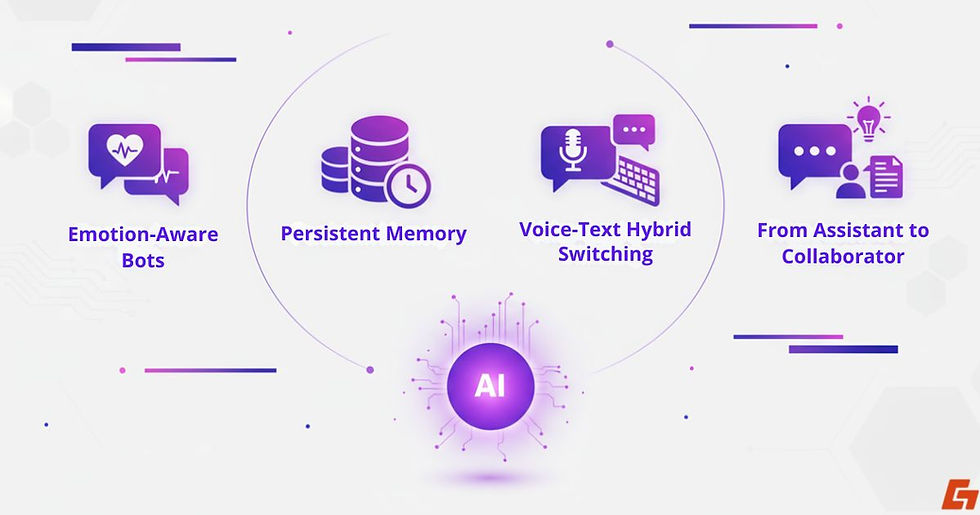
Emotion-Aware Bots Are Closer Than You Think
First up: emotion-aware bots. These aren’t sci-fi dreams anymore. Researchers are working on models that pick up on tone, sentiment, even stress, so your AI assistant might soon ask, “You sound upset. Want me to connect you to a person?”
That could change how we interact with digital systems entirely.
Persistent Memory: Your Bot Remembers Everything
Next, we’ll see persistent memory become the norm. Imagine a virtual agent that remembers your preferences, past issues, even your birthday.
One conversation isn’t just a one-off, it becomes part of an ongoing relationship. You’ll talk to it like you would a familiar colleague, not a blank slate every time.
Seamless Voice-Text Switching Is on the Horizon
Then there’s the voice-text hybrid experience. Instead of picking one or the other, we’ll switch fluidly, start a chat with your voice on your phone, finish it later by typing from your laptop.
The AI chatbot of the future will follow you across devices, remembering where you left off.
From Assistant to Collaborator
And perhaps most exciting (or alarming, depending on your view): AI chatbots as coworkers. They’ll schedule meetings, summarize emails, even brainstorm ideas.
You won’t just use them, you’ll collaborate with them. The line between tool and teammate? It’s already starting to blur.
The Conversation Is Just Beginning
From simple scripted helpers to AI chatbots that remember, adapt, and actually feel conversational, we’ve come a long way. What once passed for automation is now inching closer to something that resembles real dialogue.
But this evolution isn't just about the tech. It’s reshaping how we ask for help, how we solve problems, and even how we build trust, often without a human in sight. The boundary between machine and human interaction? It's getting thinner by the day.
So the next time you chat with support, ask yourself: does it really matter who's on the other end, as long as the AI chatbot gets you what you need?


Comments